
Skip to content
  • My RVCC
  • Apply
  • Catalog
  • Course Schedules
River Valley Community College
  • Academics
    • Academics at RVCC
    • Degrees and Certificates
    • Academic Calendar
    • College Catalog
    • Transfer Opportunities
    • High School Programs
  • Admissions
    • Apply
    • Course Schedules
    • Credit for Prior Learning
    • Take a Class
    • Student FAQs
  • Paying for RVCC
    • Tuition and Fees
    • Financial Aid
      • Overview
      • Grants
      • Work Study
      • Loans
      • Quick Links
      • Financial Aid Forms
    • Scholarship Opportunities
    • Military Education Benefits
  • Student Support
    • Advising Center
    • Counseling (Free Teletherapy)
    • English as a Second or Other Language (ESOL) at RVCC
    • Low Cost Course Materials
    • On-Campus Resources
      • Overview
      • Accessibility Services
      • Food Services
      • Parents’ Room
      • The RVCC CARES Team
      • Student Success Coaching
      • Transportation
    • Puksta Library & Tutoring
      • Puksta Library
      • Tutoring Services
      • Library Resources
    • Student Life
  • Workforce Development
    • Healthcare
      • LNA Program
      • Medical Assistant
      • Medication Nursing Assistant
    • Peer Support
    • Plumbers’ License Renewal
    • Customized Training Solutions
    • Professional & Personal Development
    • WorkReadyNH
  • About
    • A Welcome from RVCC’s President
    • About RVCC
    • Accreditation
    • Alumni
    • Art Gallery
    • Arts in April
    • Campus Safety
    • Directory
    • Donate to RVCC
    • Meet the Leadership Team
    • Non-Discrimination Policy
    • RVCC Principles
    • Strategic Plan
    • Title IX, Harassment Prevention, and Discrimination
    • Working at RVCC
  • Academics
    • Academics at RVCC
    • Degrees and Certificates
    • Academic Calendar
    • College Catalog
    • Transfer Opportunities
    • High School Programs
  • Admissions
    • Apply
    • Course Schedules
    • Credit for Prior Learning
    • Take a Class
    • Student FAQs
  • Paying for RVCC
    • Tuition and Fees
    • Financial Aid
      • Overview
      • Grants
      • Work Study
      • Loans
      • Quick Links
      • Financial Aid Forms
    • Scholarship Opportunities
    • Military Education Benefits
  • Student Support
    • Advising Center
    • Counseling (Free Teletherapy)
    • English as a Second or Other Language (ESOL) at RVCC
    • Low Cost Course Materials
    • On-Campus Resources
      • Overview
      • Accessibility Services
      • Food Services
      • Parents’ Room
      • The RVCC CARES Team
      • Student Success Coaching
      • Transportation
    • Puksta Library & Tutoring
      • Puksta Library
      • Tutoring Services
      • Library Resources
    • Student Life
  • Workforce Development
    • Healthcare
      • LNA Program
      • Medical Assistant
      • Medication Nursing Assistant
    • Peer Support
    • Plumbers’ License Renewal
    • Customized Training Solutions
    • Professional & Personal Development
    • WorkReadyNH
  • About
    • A Welcome from RVCC’s President
    • About RVCC
    • Accreditation
    • Alumni
    • Art Gallery
    • Arts in April
    • Campus Safety
    • Directory
    • Donate to RVCC
    • Meet the Leadership Team
    • Non-Discrimination Policy
    • RVCC Principles
    • Strategic Plan
    • Title IX, Harassment Prevention, and Discrimination
    • Working at RVCC
  • My RVCC
  • Apply
  • Catalog
  • Course Schedules

Information Technology & Network Administration

Associate in Science
Information Technology & Network Administration
River Valley Community College > Programs > Information Technology & Network Administration
Overview
Mission
Goals & Outcomes
Program Specific Requirements
Program of Study
Faculty
Overview

Build the technology skills organizations depend on every day

From healthcare systems and schools to small businesses and global enterprises, every organization relies on professionals who can keep networks running, troubleshoot technical problems, and support the technology that powers daily operations. River Valley’s Information Technology & Network Administration Associate of Science degree prepares you to become one of those professionals. 

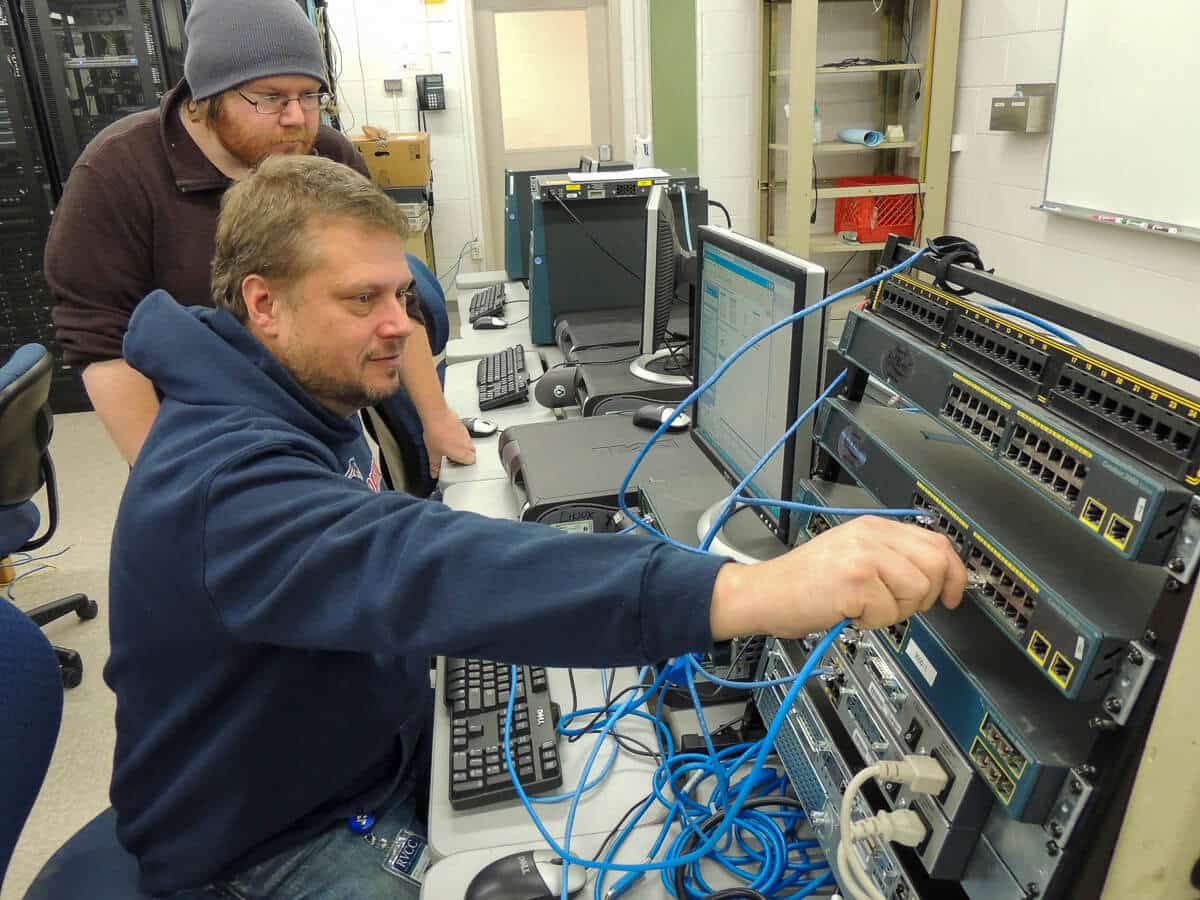
 Hands-on techical training

Through a blend of hands-on technical training and general education coursework, you’ll develop the practical skills employers seek while strengthening your communication, analytical, and problem-solving abilities. You’ll gain experience configuring networks, administering Windows and Linux systems, supporting users, implementing virtualization technologies, and applying cybersecurity best practices in modern IT environments. 

 Along the way, you’ll learn how to: 

  • Design, configure, and troubleshoot wired and wireless networks. 
  • Administer and maintain Windows Server and Linux operating systems. 
  • Support enterprise technologies including virtualization and storage solutions. 
  • Apply security principles to protect organizational systems and data. 
  • Analyze technical issues and develop effective solutions. 
  • Communicate technical concepts clearly to both technical and non-technical audiences. 
  • Work collaboratively and professionally in team-based environments. 

 Achieve your goals

Whether you’re just beginning your educational journey, returning to school to advance your career, or transferring from another institution, this program provides the flexibility and foundation to help you achieve your goals. 

Careeres

Graduates may pursue careers as;

  • network support specialists
  • systems support technicians
  • help desk professionals
  • infrastructure technicians
  • junior network administrators

Transfer

Students planning to continue their education can transfer into bachelor’s degree programs in Information Technology, Computer Science, Applied Computer Science, Cybersecurity, and related fields. 

Mission

To develop and train information technology and networking administration professionals who can help companies manage and protect their systems. 

Goals & Outcomes

Program Goals

The goal of the Information Technology and Network Administration program is to give students the knowledge and experience to advance themselves in their career of choice.

Program Outcomes

The proposed program will provide students with a strong foundation of understanding in information technology and networking. Students will learn:

  • The focused discipline of networking in technology and develop a foundation of knowledge of the field
  • To write clearly and effectively for defined audiences through a variety of strategies
  • The purpose behind their field of study, how to best interact with the people in their work environment and the career path that is best aligned with their personal goals
  • How to use multiple operating systems commonly found in the technology field today
  • Basic security principles for information assurance
  • The basics of descriptive and inferential statistics
  • Computer networking through the introduction of the Open Systems Interconnection (OSI) model, the TCP/IP protocol suite, routing and switching protocols, Wide Area Network services, and network design & implementation
  • A programming language and be able to design and implement simple programs dealing with numerical and string processing
  • To implement, maintain and protect a Microsoft Windows Server Domain
  • Graphical and command line SQL methods of creating relational databases
  • To perform ordinary tasks in the Linux operating systems
  • The methods in which emerging technologies can be deployed on current and future platforms
  • How to succeed in a networking technology position through an Internship or Capstone course
Program Specific Requirements

Information Technology and Network Administration is an open enrollment program. This means we accept students once they are accepted to River Valley; no requirements necessary. At RVCC, we believe all students should be able to complete a degree and be able to transfer or start their career as smoothly as possible.

If you have any questions about Information Technology and Network Administration, please do not hesitate to request information or reach out to the faculty.

Program of Study

Total Credits:
61 – 66

Course Sequencing

First Year: Fall Semester

Item #
Title
Credits
CSCI101R
Principles of IT I
3
CSCI110R
Introduction to Networks
3
Social Science Elective +
3

Social Science Elective

Total Credits: 3

MATH110R
Functions & Modeling I
4
ENGL101R
College Composition
4

First Year: Spring Semester

Item #
Title
Credits
CSCI102R
Principles of IT II
3
CSCI106R
Communication Infrastructure
3
CSCI121R
Switching & Routing and Wireless Essentials
3
MATH120R
Functions & Modeling II
4
Humanities/Fine Arts/World Language Elective +
3

Humanities/Fine Arts/World Language Elective

Total Credits: 3

Second Year: Fall Semester

Item #
Title
Credits
CSCI203R
Introduction to Linux
3
CSCI204R
Administering Windows Servers
3
CSCI236R
Enterprise Networking and Security and Automation
3
MATH106R
Statistics I: An Introduction to Statistical Reasoning
4
Science Elective +
4

Science Elective

Total Credits: 4

Second Year: Spring Semester

Item #
Title
Credits
CSCI175R
Introduction to C++
4
CSCI220R
Storage and Virtualization
3
CYBS120R
Network Security
3
Computer Technology Elective +
3

Computer Technology Elective

Total Credits: 3

Take the CSCI/BCPT course of your choosing.


CSCI296R
Technology Capstone
3
Total Credits:
61 – 66

Faculty

  • Cybersecurity

    The Cybersecurity Associate of Science degree prepares students to protect organizations against evolving digital threats through a comprehensive study of cybersecurity principles, technologies, and practices. Reflecting the rapidly changing cybersecurity landscape, the program has evolved from its original healthcare-specific focus to provide a balanced, industry-wide approach that prepares graduates to secure information systems across a variety of sectors, including healthcare, business, government, education, finance, and critical infrastructure.

    The curriculum integrates technical coursework with general education to develop both the practical and professional competencies expected of today’s cybersecurity workforce. Students gain hands-on experience securing networks and operating systems, investigating cyber incidents, analyzing vulnerabilities, and implementing defensive strategies while developing critical thinking, communication, and analytical skills.

    Graduates are prepared for entry-level positions such as cybersecurity analyst, information security specialist, security operations center (SOC) analyst, and IT security specialist. The program also provides a strong academic foundation for students intending to transfer to bachelor’s degree programs in Cybersecurity, Information Technology, Computer Science, Digital Forensics, and related disciplines.

    Recognizing the changing nature of cyber threats, the updated curriculum includes coursework in Security and AI Concepts, examining both the opportunities and risks associated with artificial intelligence in cybersecurity environments, and Ethical Hacking, which introduces penetration testing methodologies and adversarial thinking used to identify and mitigate vulnerabilities before they can be exploited.

    Coursework supports preparation for industry-recognized certifications such as CompTIA A+, CompTIA Security+, CompTIA Network+, Cisco Certified Network Associate (CCNA), and other credentials that enhance career readiness and professional advancement.

    Applicants must meet the College’s general admission requirements. Students attending part-time may require more than two years to complete the program.

    Students must earn a grade of “C” or higher in all required CSCI and CYBS courses to progress within the program and graduate.

    Students who are unable to pass a criminal background check may encounter limitations in obtaining or maintaining employment in the information technology field and should consider alternative educational pathways. 

    Program Mission

    To develop and train cybersecurity professionals who can protect organizational systems, networks, data, and emerging technologies through ethical practice, technical expertise, and lifelong learning in an evolving digital landscape.   

    Program / Student Outcomes

    Graduates of the Cybersecurity degree program will be able to:

    • Apply foundational cybersecurity concepts and frameworks to protect information systems and organizational assets.
    • Identify, assess, and mitigate cybersecurity risks using industry-standard security controls and best practices.
    • Configure, monitor, and secure networks, operating systems, and endpoint devices within enterprise environments.
    • Analyze security events and incidents to support detection, response, investigation, and recovery efforts.
    • Conduct vulnerability assessments and apply ethical hacking methodologies to identify weaknesses and recommend remediation strategies.
    • Evaluate the impact of emerging technologies, including artificial intelligence, and implement strategies to address the security challenges and opportunities they present.
    • Administer and support Windows and Linux operating systems commonly found in cybersecurity environments.
    • Apply principles of digital forensics to preserve, examine, and interpret evidence related to cyber incidents.
    • Communicate technical information effectively to both technical and non-technical audiences through written, verbal, and collaborative methods.
    • Demonstrate ethical reasoning, professionalism, and legal awareness in the practice of cybersecurity.
    • Integrate technical knowledge and practical experience through capstone or experiential learning opportunities that prepare them for employment, professional certification, and continued academic study.
    • Evaluate career pathways and educational opportunities that support advancement into specialized cybersecurity roles and bachelor’s degree programs. 

    NOTE

    * Many courses have co/prerequisites. See course descriptions for requirements. 

    ** Total program credits are presented as a range and may vary based on transfer coursework and elective selection. Students who complete all courses at RVCC follow the higher credit total. See Graduation Requirements for more details.

    Total Credits:
    61 – 66

    Course Sequencing

    First Year: Fall Semester

    Item #
    Title
    Credits
    CSCI101R
    Principles of IT I
    3
    CSCI110R
    Introduction to Networks
    3
    CYBS101R
    Principles of Information Assurance
    3
    Social Science Elective
    3

    Social Science Elective

    Total Credits: 3


    MATH110R
    Functions & Modeling I
    4

    First Year: Spring Semester

    Item #
    Title
    Credits
    CSCI102R
    Principles of IT II
    3
    CYBS120R
    Network Security
    3
    CYBS130R
    Enterprise Security Management
    3
    CYBS140R
    Secure Electronic Commerce
    3
    ENGL101R
    College Composition
    4

    Second Year: Fall Semester

    Item #
    Title
    Credits
    CSCI203R
    Introduction to Linux
    3
    CYBS150R
    Security & AI Concepts
    3
    CYBS250R
    Digital Forensics
    3
    MATH106R
    Statistics I: An Introduction to Statistical Reasoning
    4
    English/Humanities/Fine Arts/World Language/Science/Mathematics or Social Science Elective
    3 – 4

    English/Humanities/Fine Arts/World Language/Science/Mathematics or Social Science Elective

    Total Credits: 3 – 4


    Second Year: Spring Semester

    Item #
    Title
    Credits
    CSCI175R
    Introduction to C++
    4
    CYBS270R
    Ethical Hacking
    3
    CSCI296R
    Technology Capstone
    3
    Science Elective
    4

    Science Elective

    Total Credits: 4


    Humanities/Fine Arts/World Language Elective
    3

    Humanities/Fine Arts/World Language Elective

    Total Credits: 3


    Total Credits:
    61 – 66

    Overview

    Program

    Computer Technology

    Credits

    61 – 66
  • Cybersecurity

    The Cybersecurity Associate of Science degree prepares students to protect organizations against evolving digital threats through a comprehensive study of cybersecurity principles, technologies, and practices. Reflecting the rapidly changing cybersecurity landscape, the program has evolved from its original healthcare-specific focus to provide a balanced, industry-wide approach that prepares graduates to secure information systems across a variety of sectors, including healthcare, business, government, education, finance, and critical infrastructure.

    The curriculum integrates technical coursework with general education to develop both the practical and professional competencies expected of today’s cybersecurity workforce. Students gain hands-on experience securing networks and operating systems, investigating cyber incidents, analyzing vulnerabilities, and implementing defensive strategies while developing critical thinking, communication, and analytical skills.

    Graduates are prepared for entry-level positions such as cybersecurity analyst, information security specialist, security operations center (SOC) analyst, and IT security specialist. The program also provides a strong academic foundation for students intending to transfer to bachelor’s degree programs in Cybersecurity, Information Technology, Computer Science, Digital Forensics, and related disciplines.

    Recognizing the changing nature of cyber threats, the updated curriculum includes coursework in Security and AI Concepts, examining both the opportunities and risks associated with artificial intelligence in cybersecurity environments, and Ethical Hacking, which introduces penetration testing methodologies and adversarial thinking used to identify and mitigate vulnerabilities before they can be exploited.

    Coursework supports preparation for industry-recognized certifications such as CompTIA A+, CompTIA Security+, CompTIA Network+, Cisco Certified Network Associate (CCNA), and other credentials that enhance career readiness and professional advancement.

    Applicants must meet the College’s general admission requirements. Students attending part-time may require more than two years to complete the program.

    Students must earn a grade of “C” or higher in all required CSCI and CYBS courses to progress within the program and graduate.

    Students who are unable to pass a criminal background check may encounter limitations in obtaining or maintaining employment in the information technology field and should consider alternative educational pathways. 

    Program Mission

    To develop and train cybersecurity professionals who can protect organizational systems, networks, data, and emerging technologies through ethical practice, technical expertise, and lifelong learning in an evolving digital landscape.   

    Program / Student Outcomes

    Graduates of the Cybersecurity degree program will be able to:

    • Apply foundational cybersecurity concepts and frameworks to protect information systems and organizational assets.
    • Identify, assess, and mitigate cybersecurity risks using industry-standard security controls and best practices.
    • Configure, monitor, and secure networks, operating systems, and endpoint devices within enterprise environments.
    • Analyze security events and incidents to support detection, response, investigation, and recovery efforts.
    • Conduct vulnerability assessments and apply ethical hacking methodologies to identify weaknesses and recommend remediation strategies.
    • Evaluate the impact of emerging technologies, including artificial intelligence, and implement strategies to address the security challenges and opportunities they present.
    • Administer and support Windows and Linux operating systems commonly found in cybersecurity environments.
    • Apply principles of digital forensics to preserve, examine, and interpret evidence related to cyber incidents.
    • Communicate technical information effectively to both technical and non-technical audiences through written, verbal, and collaborative methods.
    • Demonstrate ethical reasoning, professionalism, and legal awareness in the practice of cybersecurity.
    • Integrate technical knowledge and practical experience through capstone or experiential learning opportunities that prepare them for employment, professional certification, and continued academic study.
    • Evaluate career pathways and educational opportunities that support advancement into specialized cybersecurity roles and bachelor’s degree programs. 

    NOTE

    * Many courses have co/prerequisites. See course descriptions for requirements. 

    ** Total program credits are presented as a range and may vary based on transfer coursework and elective selection. Students who complete all courses at RVCC follow the higher credit total. See Graduation Requirements for more details.

    Total Credits:
    61 – 66

    Course Sequencing

    First Year: Fall Semester

    Item #
    Title
    Credits
    CSCI101R
    Principles of IT I
    3
    CSCI110R
    Introduction to Networks
    3
    CYBS101R
    Principles of Information Assurance
    3
    Social Science Elective
    3

    Social Science Elective

    Total Credits: 3


    MATH110R
    Functions & Modeling I
    4

    First Year: Spring Semester

    Item #
    Title
    Credits
    CSCI102R
    Principles of IT II
    3
    CYBS120R
    Network Security
    3
    CYBS130R
    Enterprise Security Management
    3
    CYBS140R
    Secure Electronic Commerce
    3
    ENGL101R
    College Composition
    4

    Second Year: Fall Semester

    Item #
    Title
    Credits
    CSCI203R
    Introduction to Linux
    3
    CYBS150R
    Security & AI Concepts
    3
    CYBS250R
    Digital Forensics
    3
    MATH106R
    Statistics I: An Introduction to Statistical Reasoning
    4
    English/Humanities/Fine Arts/World Language/Science/Mathematics or Social Science Elective
    3 – 4

    English/Humanities/Fine Arts/World Language/Science/Mathematics or Social Science Elective

    Total Credits: 3 – 4


    Second Year: Spring Semester

    Item #
    Title
    Credits
    CSCI175R
    Introduction to C++
    4
    CYBS270R
    Ethical Hacking
    3
    CSCI296R
    Technology Capstone
    3
    Science Elective
    4

    Science Elective

    Total Credits: 4


    Humanities/Fine Arts/World Language Elective
    3

    Humanities/Fine Arts/World Language Elective

    Total Credits: 3


    Total Credits:
    61 – 66

    Overview

    Program

    Computer Technology

    Credits

    61 – 66
  • Cybersecurity

    The Cybersecurity Associate of Science degree prepares students to protect organizations against evolving digital threats through a comprehensive study of cybersecurity principles, technologies, and practices. Reflecting the rapidly changing cybersecurity landscape, the program has evolved from its original healthcare-specific focus to provide a balanced, industry-wide approach that prepares graduates to secure information systems across a variety of sectors, including healthcare, business, government, education, finance, and critical infrastructure.

    The curriculum integrates technical coursework with general education to develop both the practical and professional competencies expected of today’s cybersecurity workforce. Students gain hands-on experience securing networks and operating systems, investigating cyber incidents, analyzing vulnerabilities, and implementing defensive strategies while developing critical thinking, communication, and analytical skills.

    Graduates are prepared for entry-level positions such as cybersecurity analyst, information security specialist, security operations center (SOC) analyst, and IT security specialist. The program also provides a strong academic foundation for students intending to transfer to bachelor’s degree programs in Cybersecurity, Information Technology, Computer Science, Digital Forensics, and related disciplines.

    Recognizing the changing nature of cyber threats, the updated curriculum includes coursework in Security and AI Concepts, examining both the opportunities and risks associated with artificial intelligence in cybersecurity environments, and Ethical Hacking, which introduces penetration testing methodologies and adversarial thinking used to identify and mitigate vulnerabilities before they can be exploited.

    Coursework supports preparation for industry-recognized certifications such as CompTIA A+, CompTIA Security+, CompTIA Network+, Cisco Certified Network Associate (CCNA), and other credentials that enhance career readiness and professional advancement.

    Applicants must meet the College’s general admission requirements. Students attending part-time may require more than two years to complete the program.

    Students must earn a grade of “C” or higher in all required CSCI and CYBS courses to progress within the program and graduate.

    Students who are unable to pass a criminal background check may encounter limitations in obtaining or maintaining employment in the information technology field and should consider alternative educational pathways. 

    Program Mission

    To develop and train cybersecurity professionals who can protect organizational systems, networks, data, and emerging technologies through ethical practice, technical expertise, and lifelong learning in an evolving digital landscape.   

    Program / Student Outcomes

    Graduates of the Cybersecurity degree program will be able to:

    • Apply foundational cybersecurity concepts and frameworks to protect information systems and organizational assets.
    • Identify, assess, and mitigate cybersecurity risks using industry-standard security controls and best practices.
    • Configure, monitor, and secure networks, operating systems, and endpoint devices within enterprise environments.
    • Analyze security events and incidents to support detection, response, investigation, and recovery efforts.
    • Conduct vulnerability assessments and apply ethical hacking methodologies to identify weaknesses and recommend remediation strategies.
    • Evaluate the impact of emerging technologies, including artificial intelligence, and implement strategies to address the security challenges and opportunities they present.
    • Administer and support Windows and Linux operating systems commonly found in cybersecurity environments.
    • Apply principles of digital forensics to preserve, examine, and interpret evidence related to cyber incidents.
    • Communicate technical information effectively to both technical and non-technical audiences through written, verbal, and collaborative methods.
    • Demonstrate ethical reasoning, professionalism, and legal awareness in the practice of cybersecurity.
    • Integrate technical knowledge and practical experience through capstone or experiential learning opportunities that prepare them for employment, professional certification, and continued academic study.
    • Evaluate career pathways and educational opportunities that support advancement into specialized cybersecurity roles and bachelor’s degree programs. 

    NOTE

    * Many courses have co/prerequisites. See course descriptions for requirements. 

    ** Total program credits are presented as a range and may vary based on transfer coursework and elective selection. Students who complete all courses at RVCC follow the higher credit total. See Graduation Requirements for more details.

    Total Credits:
    61 – 66

    Course Sequencing

    First Year: Fall Semester

    Item #
    Title
    Credits
    CSCI101R
    Principles of IT I
    3
    CSCI110R
    Introduction to Networks
    3
    CYBS101R
    Principles of Information Assurance
    3
    Social Science Elective
    3

    Social Science Elective

    Total Credits: 3


    MATH110R
    Functions & Modeling I
    4

    First Year: Spring Semester

    Item #
    Title
    Credits
    CSCI102R
    Principles of IT II
    3
    CYBS120R
    Network Security
    3
    CYBS130R
    Enterprise Security Management
    3
    CYBS140R
    Secure Electronic Commerce
    3
    ENGL101R
    College Composition
    4

    Second Year: Fall Semester

    Item #
    Title
    Credits
    CSCI203R
    Introduction to Linux
    3
    CYBS150R
    Security & AI Concepts
    3
    CYBS250R
    Digital Forensics
    3
    MATH106R
    Statistics I: An Introduction to Statistical Reasoning
    4
    English/Humanities/Fine Arts/World Language/Science/Mathematics or Social Science Elective
    3 – 4

    English/Humanities/Fine Arts/World Language/Science/Mathematics or Social Science Elective

    Total Credits: 3 – 4


    Second Year: Spring Semester

    Item #
    Title
    Credits
    CSCI175R
    Introduction to C++
    4
    CYBS270R
    Ethical Hacking
    3
    CSCI296R
    Technology Capstone
    3
    Science Elective
    4

    Science Elective

    Total Credits: 4


    Humanities/Fine Arts/World Language Elective
    3

    Humanities/Fine Arts/World Language Elective

    Total Credits: 3


    Total Credits:
    61 – 66

    Overview

    Program

    Computer Technology

    Credits

    61 – 66

  • Academic Calendar
  • Academics at RVCC
  • College Catalog
  • Course Descriptions
  • Degrees and Certificates
  • High School Programs
  • Transfer Opportunities
  • STEM and Advanced ManufacturingSTEM and Advanced Manufacturing

60-61 Credits Required

Request Info
Apply Now

Program Contact

Robert Morris
[email protected]

River Valley Community College Logo

Tel: (603) 542-7744
[email protected]
Admissions: [email protected]
 Fax:  603-543-1844

Twitter Facebook-f Instagram Youtube

Part of The Community College System of New Hampshire

Claremont Campus
1 College Place
Claremont, NH 03743
603-542-7744

Keene Academic Center
88 Winchester Street
Keene, NH 03431
603-542-7744 x 5725
Classes 
Keene State College

Lebanon Academic Center
15 Hanover Street
Lebanon, NH 03766

603-443-4200

CPR Training
Donate
Request a Transcript
Contact Us
Graduation Information
Current Students
Apply Now
Cost of Attendance
Current Faculty / Staff
Registrar
  • Accessibility Policy
  • Consumer Information
  • Non Discrimination Policy
  • Privacy Policy
  • Sitemap
  • Title IX Resources
  • Working at RVCC

© 2026 - River Valley Community College

Website Feedback

Site by MRW & Opus.