Overview
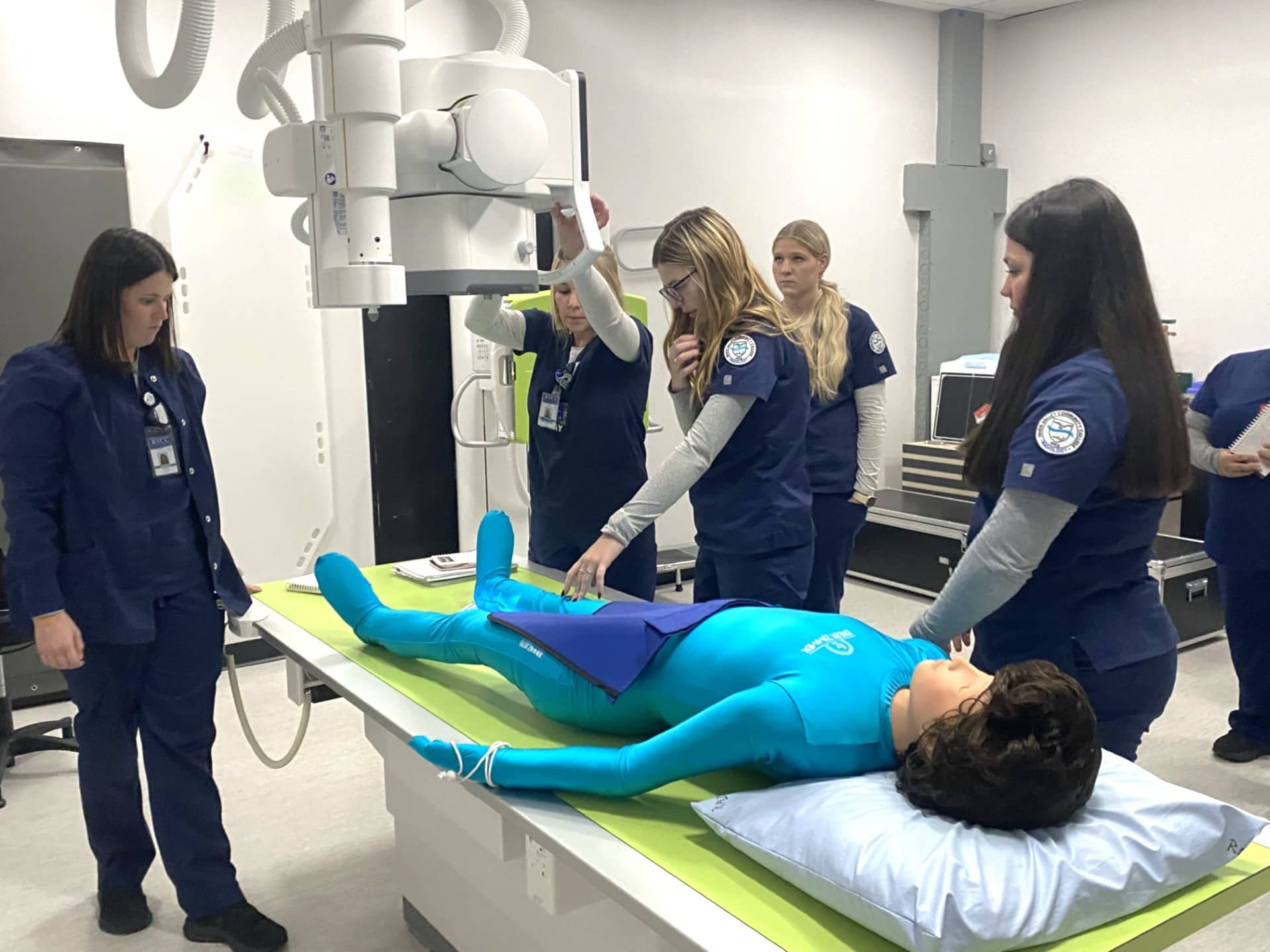
Radiologic Technologists are a vital part of the medical team. They are responsible for producing x-rays or images for a doctor to interpret and help diagnose and treat a patient. The Radiologic Technology program at River Valley has been developed with the goal of creating passionate radiologic technologists. Our program is designed with working adults in mind by offering a schedule that meets four days a week.
The program offers students cutting edge technology including experiences in a variety of settings such as:
- Operating Room
- Emergency Room
- Intensive Care Units
- Portable Imaging
Career Options
- Post certificates in advance imaging modalities (CT, MRI, Mammography, Bone density, Interventional radiography)
- Nuclear medicine
- Radiation therapy
- PACS administrator
- Radiology Assistant
- Radiology educator
- Health administration
Accreditation Information
The RVCC Radiologic Technology Program is accredited by the
Joint Review Committee on Education in Radiologic Technology (JRCERT)
20 N. Wacker Drive, Suite 2850
Chicago, IL 60606-3182
312-704-5300
Email: [email protected]
www.jrcert.org
The program’s current accreditation award is 8 years. The current accreditation award letter can be found here.
JRCERT Award Letter
General program accreditation information and the current accreditation award letter can be found here: https://www.jrcert.org/programs/river-valley-community-college/
Articulation Agreements:
Southern New Hampshire University
Graduate requirements:
To earn an Associate Degree in Radiologic Technology Sciences from River Valley Community College, a student must:
- Successfully complete the didactic and all clinical competencies in a maximum length of three years.
- Achieve a Cumulative Grade Point Average (GPA) of 2.0 or higher in all courses taken at River Valley Community College (including remedial or developmental coursework/credits).
- Complete the Intent to graduate form.
The following items are needed to complete a Radiologic Technology Degree application:
1. Submit a completed admission application.
2. Attend an in-person information session.
- Thursday, September 24th, 2026 5-6 pm
- Wednesday, October 28th, 2026 12-1pm
- Thursday, November 19th, 2026 3-4 pm
3. Order a copy of your transcripts (High school/GED or HiSet and college transcript(s)). Have them sent directly to RVCC electronically to [email protected], or mailed to:
River Valley Community College
1 College Place
Claremont, NH 03743
4. Fieldwork Observation requirement. Download this form. Attend an observation between 4-8 hours, fill out the form and have it signed, submit the completed form in the application portal or by emailing [email protected]. See our current list of area healthcare facilities where observations can be done, or choose a location near you.
5. Complete the Rad Tech Essential Functions & Technical Skills form which will be automatically emailed to [email protected] once you hit the submit button.
Acceptance to the program is based on the Rad Tech Admissions Rubric.
Criminal background checks, fingerprinting, immunization records, drug screens and CPR certification may be required for clinical placement and must be submitted prior to starting a clinical practicum. The costs of these are the responsibility of the student.
For details and more information about this program, please read and review the 2026 – 2027 Radiologic Technology Student Handbook (PDF).
Priority deadline to submit the following items is December 1st each year.
The total cost of the program can be found here: https://www.rivervalley.edu/paying-for-rvcc/tuition-and-fees/
Financial Aid & Scholarships: To learn more about how to apply for Financial Aid, please visit our website. Students who have completed a FAFSA. (Free Application for Federal Student Aid).info
Transfer Evaluation Policy – Credit For Prior Learning Policy Weblink
Course Sequencing
First Year: Fall Semester
First Year: Spring Semester
First Year: Summer Semester
Second Year: Fall Semester
Second Year: Spring Semester
The clinical coordinator will assign students three clinical sites: The first site will be the first year in the Spring and summer semester. The second site will be during the 2nd year Fall semester and the third will be during the 2nd year Spring semester. Clinical hours are day time only and do not include nights/weekends.
Each student is required to provide their own transportation to and from the clinic. Students may be required to drive up to 2 hours each way to accommodate their clinic scheduling. Students must complete all orientation processes as assigned by their respective hospitals and are responsible for all costs. This includes health requirements for allied health clinical clearance, criminal background check, and drug and alcohol testing.
Comprehensive health insurance is required to engage in clinical placements.
Students will be required to purchase uniforms according to RVCC Radiologic Technology clinical dress code.
Students most demonstrate competence in all 10 Patient Care competencies, 36 mandatory competencies, and 15 elective competency procedures required by the ARRT (American Registry of Radiologic Technology) prior to graduation.
Criminal background checks are required prior to beginning the program in the Fall and again each year following. Checks are completed through RVCC’s approved vendor, Castlebranch. Background checks from previous employers or other vendors are not accepted. No student is exempt. Students will be instructed as to when these checks are to be completed.
Complete drug and alcohol testing may be required by the clinical site. These tests are completed through RVCC’s approved vendor, Castlebranch. Students will be instructed as to when these tests are to be completed
RVCC maintains a list of hospitals that have, through formal affiliation agreements, agreed to act as the clinical agencies through which RVCC students in this program complete the required clinical education. These agencies must also be approved by JRCERT. It is for this reason that only these hospitals may be used in conjunction with the Radiologic Technology program. Click here for a list of approved clinical sites.
The semester clinical grade comprises multiple assessment tools as listed in the course syllabus. A student must receive an 83.33% or greater for the clinical component to pass the course. If a student does not complete the requirements, they will be issued a no pass (NP). If a student is dismissed from the clinical semester because of performance or behavioral issues, they will be issued an AF. Any student receiving a failing grade in a clinical course will be dismissed from the program and is not eligible to reapply. Clinical practice is the essence of the profession and a failure in the clinical environment indicates that the student is not competent to continue in the program.
The mission of the Radiologic Technology Program at River Valley Community College is to prepare competent, entry-level radiographers who possess the knowledge, technical skills, and professional values required to excel in the field of medical imaging. The program is dedicated to promoting the highest standards of image quality and patient care, fostering ethical and professional behavior while cultivating a commitment to person-centered care and lifelong learning in a diverse and evolving healthcare environment.
Program Goals & Outcomes
GOAL: To prepare students/graduates to demonstrate professional values and ethical behaviors in the work place.
Educational Outcomes – Graduates will:
- demonstrate positive ethical behaviors.
- assist the patients with consideration and respect to their personal beliefs and without discrimination.
- conduct themselves in a professional manner.
GOAL: To prepare students/graduates to demonstrate competencies in the essential skills of medical imaging.
Educational Outcomes – Graduates will:
- competently practice general diagnostic medical radiography in any clinical setting.
- practice radiation protection and radiation safety techniques in ways that minimizes radiation exposure to patients, self and others.
- meet the clinical competency requirements for each semester.
- participate in professional activities and continuing education.
GOAL: To prepare students/graduates to communicate effectively and professionally in the medical environment.
Educational Outcomes – Graduates will:
- demonstrate good communication skills.
GOAL: To prepare students/graduates to demonstrate critical thinking, problem solving skills and lifelong learning.
Educational Outcomes – Graduates will:
- think critically to act appropriately in solving problems of non-routine and emergency situations.
GOAL: To prepare graduates to successfully meet entry level expectations of employers.
Educational Outcomes – Graduates will:
- perform at entry level expectation.
- successfully complete the Radiography Program.
- become employed within one year of graduation.
- promote continued professional and personal growth and lifelong learning.

Eileen Glover (she/her/they/them)
AdministrationInterim President; Professor, Practical Nursing
Jessica Horton (she/her)
Allied Health | Radiologic TechnologyDepartment Co-Chair, Allied Health; Associate Professor & Program Director, Radiologic Technology
Michelle Sweeney
Allied Health | Radiologic TechnologyAssistant Professor & Clinical Coordinator, Radiologic Technology
CCSNH Grading System link: https://catalog.rivervalley.edu/grading-system
Radiologic Technology Program Grading System:
Grading Scale
Grade | Quality Points | 10-point scale |
A | 4.0 | 93 – 100 |
A- | 3.7 | 90 – 92 |
B+ | 3.3 | 87 – 89 |
B | 3.0 | 83 – 86 |
B- | 2.7 | 80 – 82 |
C+ | 2.3 | 77 – 79 |
C | 2.0 | 73 – 76 |
C- | 1.7 | 70 – 72 |
D+ | 1.3 | 67 – 69 |
D | 1.0 | 63 – 66 |
D- | 0.7 | 60 – 62 |
F | 0.0 | 0 – 59 |
Program Specific Grade Requirements
All students must pass all Clinical Practicums (RADT 121R,
RADT 122R, RADT 223R, and RADT 224R) with a “B” or higher; all other
RADT courses with a “C+” or higher; and all Liberal Arts Core courses
with “C” or higher.
Grievance Policy
The River Valley Community College grievance procedure
regarding grades or disciplinary proceedings are in the College Handbook. Any
student who feels that their rights have been violated may file a grievance
following the procedure below. In the case of a grievance alleging
discrimination based on race, color, religion, national or ethnic origin, age,
sex, sexual orientation, marital status, disability, gender identify or
expression, genetic information and veteran status, as defined under applicable
law, the student may also report the conduct to the College’s Affirmative
Action/Equity Officer and/or Title IX Coordinator. In the case of a grievance
alleging discrimination, the college may also initiate an investigation and
take appropriate steps including, but not limited to, referring the matter to
the appropriate College Official for disciplinary action.
1. Prior to filing a grievance, the
student is encouraged to meet with the individual who has allegedly violated
his or her rights, e.g., instructor, staff member, or student, to resolve the
issue informally.
2. If the issue cannot be resolved by
pursuing the process in Step 1, or the individual elects not to resolve the
matter informally as prescribed in Step 1, a formal grievance in writing must
be submitted to:
a. The Vice President of Academic &
Student Affairs for grievances related to the instructional process (see
college catalog or student handbook for separate process for Grade Change/Grade
Appeal), or for grievances not related to the instructional process.
b. The grievance must be submitted within
two (2) weeks of the date the grievance knew or reasonably should have known,
of the alleged violation. The grievance shall specify the right claimed to have
been violated and state briefly the underlying facts.
3. The Vice President of Academic & Student
Affairs, or designee, will meet with the individual alleged to have violated
the student’s rights. The VPASA, or designee, may attempt to resolve the issue
informally at this stage. If a resolution is not possible and the VPASA or
designee determines that the grievance alleges facts which if true constitute a
violation of the student’s rights and has been timely filed, the matter will be
forwarded to the Judicial Advisor who convenes the Judicial Committee within
two (2) weeks of the receipt of the formal grievance. If the VPASA or designee
determines that the grievance does not state a violation of the student’s
rights or is untimely, the VPASA will provide a written explanation to the student and the matter will be considered resolved at that point.
Essential Function List:
- Reach and manipulate equipment to its highest position (6’). Can raise objects from a lower to a higher position or move objects horizontally from position to position. (This factor requires the substantial use of the upper extremities and back muscles.)
- Move and stand wheelchair and/ or stretcher and help patient on/off imaging table.
- Possess mobility, coordination, and strength to push, pull or transfer heavy objects. Lift a minimum of 50 pounds and ensure patient safety.
- Possess manual dexterity, mobility, and stamina to perform AHA Basic Life Support.
- Move from room to room and maneuver in small spaces.
- Demonstrate manual dexterity to perform necessary manipulation such as drawing doses with syringes, manipulating locks, sterile and aseptic techniques.
- Use sufficient eyesight to observe patients and evaluate radiographic quality.
- Visually monitor patients/charts/machine indicator lights in dimly lit conditions
- Read and apply appropriate information and instructions contained in requisitions, notes, and patient charts.
- Possess sufficient hearing to assess patient’s needs, follow instructions, communicate with other health care workers, as well as respond to audible sounds of radiographic equipment. (Please comment if corrective devices are required.)
- Communicate in a clear and concise manner with patients of all ages, including obtaining health history and other pertinent information.
- Understand and apply clinical instructions given by department personnel.
- Able to read, comprehend, and write legibly in the English language.
- Be able to adapt to changing environments and schedules.
- Establish rapport with fellow students, coworkers, patients, and families.
- Function under stressful conditions.
- Free from impairing substances.
- Able to convey sensitivity, respect, tact, and a mentally healthy attitude.
- Endure a minimum of two hours of didactic instruction in a normal classroom environment.
- Have physical stamina to stand and walk for 8 hours or more in a clinical setting.
- Can bend the body downward and forward by bending at the spine and waist (This factor requires full use of lower extremities and back muscles).
- Ability to flex and extend all joints freely.
 Health Sciences and Services